Reading Basquiat Exploring Ambivalence in American Art Jordana Moore Saggese

I recently discovered a photograph of Jean-Michel Basquiat that has forever changed the mode I think nearly him. The prototype isn't the one of him from 1985, when he was 24 years one-time and at the acme of his early on fine art stardom, reclining barefoot in a nighttime Armani arrange on the comprehend of The New York Times Magazine. Nor is it the i where he is shirtless with dreadlocks, sporting battle gloves next to a fully clothed and specterlike Andy Warhol, as he appeared on a affiche advertising their collaborative evidence, "Warhol, Basquiat," at the Tony Shafrazi Gallery in SoHo that same year. It isn't even an before ane taken in 1982 by the famed Harlem Renaissance photographer James Van Der Zee, then 95, in which a young Basquiat is dressed in a plaid adapt jacket, stroking a cat that's sprawled across his paint-splattered jeans.
Instead, the internet gifted me with another Basquiat. In the photo I establish, he's dressed in a plain white T-shirt as he sits on a metal chair with his head pressed downward against a table, mesmerized by what he's drawing with his right manus on the paper before him. His left hand is tightly clasped around another pencil, while his tiny, unpicked Afro holds ii more than. Basquiat was 11 years sometime when the picture was taken, in 1972, by a teacher in his sixth-grade classroom at P.Due south. 101 in Bensonhurst, Brooklyn. Information technology would be some other decade before he'd embark on his meteoric rise in the art earth, on his manner to becoming the nearly famous Black creative person of his generation. The popular mythology surrounding Basquiat's origin story—his journey from couch-hopping graffiti creative person to the center of New York's surging 1980s art scene—was cemented tragically by his decease in 1988 at the age of 27 from a drug overdose. But what struck me nearly virtually this image of a preteen Jean-Michel lost in his own creativity and imagination is that it's both show of and witness to another aspect of the Basquiat narrative: proof that his talent was not just prodigious just also recognized and even cultivated by the people closest to him early on.
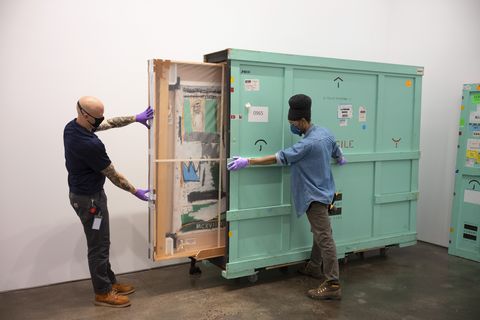
It'south this Basquiat who is the subject of the new exhibition "Jean-Michael Basquiat: Male monarch Pleasure©," which opens in April at the Starrett-Lehigh Building in New York's Chelsea gallery district. The show was assembled by his younger sisters, Lisane Basquiat and Jeanine Heriveaux, who are co-administrators of his estate, along with their stepmother, Nora Fitzpatrick. More than 200 paintings and drawings from their private drove will exist on view—many previously unseen—alongside a selection of photographs, personal artifacts, and multimedia presentations, including total-scale re-creations of the Basquiat family living and dining rooms. Information technology's also the start exhibition overseen by the Basquiat family unit, which has often been relegated to the margins of the conversation about his growth and evolution every bit an creative person.
"King Pleasure©" volition encompass the course of Basquiat's storied career and short life also as offer a personal reflection on his legacy through the eyes of his siblings. By offering an unprecedented window into his determinative years, the show also aims to upend the long-continuing racial stereotypes that have frequently clouded his work and reveal the cardinal part that his Puerto Rican and Haitian heritage and relationship with his Black family played in nurturing his inventiveness.
"Jean-Michel is and then widely celebrated in and then many different industries," Lisane, the elder of his sisters, who was four years his junior, tells me. "We wanted to share a little more of the personal side of him with the world. And nosotros've had these works in the warehouse for over xxx years, and people haven't seen them."
For Jeanine, who was seven years younger, putting together "Male monarch Pleasure©" has been cathartic. "It's been a beautiful feel to recapture the stories of our family unit and our memories of growing up and Jean-Michel," she says, noting that people oftentimes confess their stupor when they larn that he had two sisters and a family with whom he kept in contact throughout his life. "We did have a relationship with him until he passed. And nosotros'd like to add together that narrative."
"Jeanine and I actually are the only two people who can tell this story," Lisane says. "In some ways, it'south equally much for us as it is for the public. It's just a way of documenting this incredible character in our family."
To help bring "King Pleasance©" to life, the sisters enlisted Ghanaian-British architect Sir David Adjaye. In structuring the exhibition, Adjaye, who along with Philip Freelon designed the Smithsonian National Museum of African American History and Culture in Washington, D.C., sought to capture the fullness of Basquiat's life in the show'due south arc.
"What was securely revelatory for me was understanding Basquiat as a member of his family unit. I just had him as a kind of lonely effigy, disconnected from his family and everyone, sort of somehow going into the world as this haunted [individual]. Just he actually was deeply connected to his family," Adjaye says. "There is a sense that somehow his genius couldn't come up from his family unit, but he grew up in an intellectual family and was really stimulated by the various sophisticated ideas of the time. He didn't just stumble on this. He was brought upwardly in it."

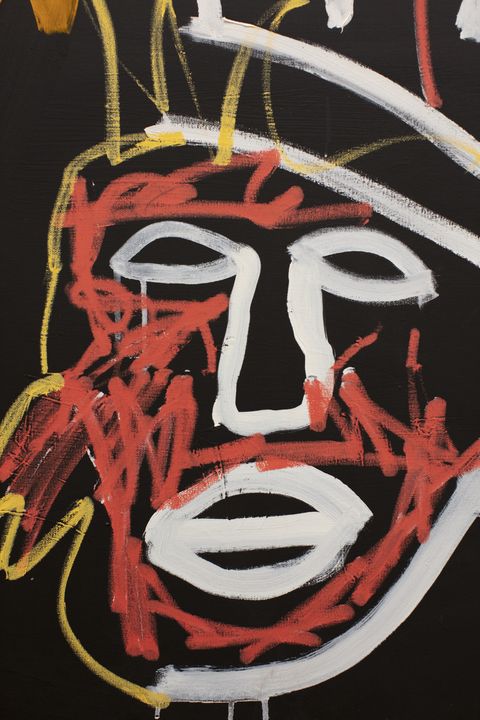
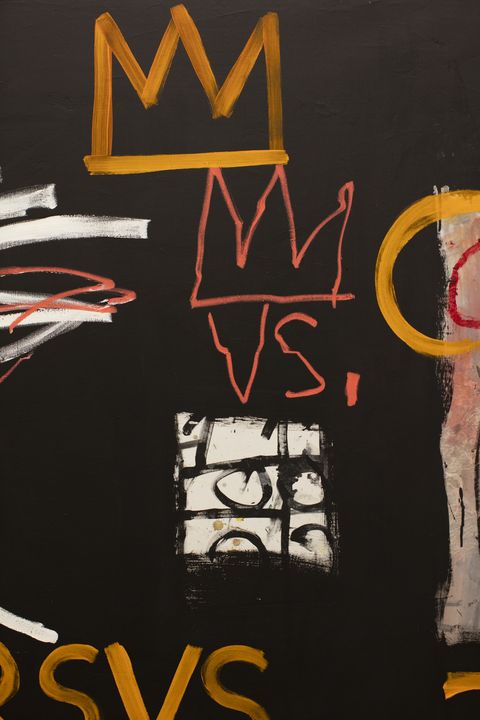
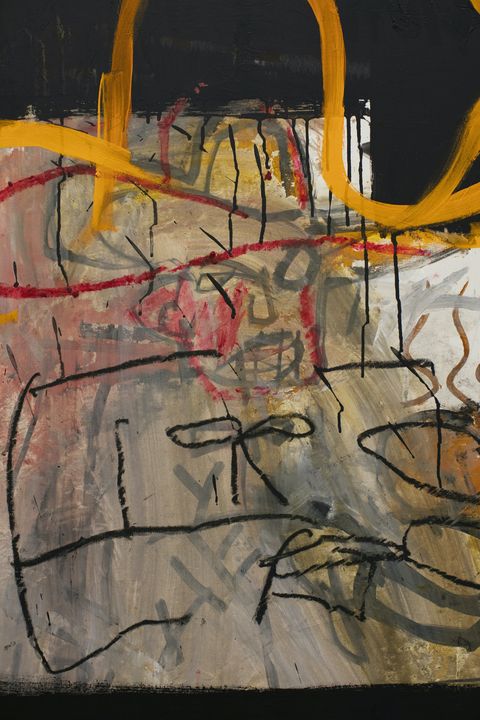
A series of details from Untitled (Cowboy and Indian).
In the brief span of his artful life, Basquiat was incredibly prolific. It is estimated that he left backside well-nigh 2,000 completed works at the time of his death. By so, he was already an established presence in the booming art market of the 1980s, having created a corpus of paintings, drawings, and other works that drew upon influences similar jazz and history and bridged ii ascendant aesthetic movements of the era, neo-expressionism and hip-hop.
These days, if you desire to encounter a Basquiat, you don't have to look very far. His crowns, skeletal figures, masked faces, and text fragments now seem to exist about everywhere—emblazoned on T-shirts, hats, jackets, scented candles, skateboards, sofa throws, Dr. Martens, and Converse sneakers. (I've even purchased Basquiat face up masks for my kindergartner.) Just concluding fall, Tiffany & Co. unveiled an advertizement entrada with Beyoncé, Jay-Z, a 128-carat diamond, and Basquiat's rarely seen 1982 painting Equals Pi, which prominently features a robin'south-egg blue.
Up until recently, Lisane and Jeanine have focused primarily on brand management of the Basquiat manor, an occupation they took up after the death of their father, Gerard Basquiat, in 2013; he had served equally its previous ambassador. Both women have extensive business organization backgrounds: In improver to overseeing the estate, Lisane, who was a corporate executive, is as well a life strategist and entrepreneur; Jeanine has worked in finance.
To the sisters, the broad availability of Jean-Michel'southward work comports with his own approach to making fine art, which he created on every surface he had access to, from walls, tabletops, and napkins to leather jackets, unhinged doors, and disused window frames.
"We ain the copyright to all works," Jeanine says. "And from our standpoint, the licensing has actually immune the public to see his works that they might not take otherwise seen considering they might not have access to a museum or might not be familiar with them." Lisane, nodding, concurs. "People can access Jean-Michel's works through images that are on different materials," she says. "That is also a way that his legacy continues."
Despite the credible ubiquity of Basquiat'southward work, interest in it remains at an all-time high. In 2018, a career-spanning retrospective filled four floors of the Frank Gehry–designed Fondation Louis Vuitton in Paris. The post-obit twelvemonth, there were the dorsum-to-back exhibitions "Jean-Michel Basquiat" at the Brant Foundation and "Basquiat'southward Defacement: The Untold Story" at the Guggenheim in New York. "Writing the Futurity: Basquiat and the Hip-Hop Generation" opened at the Museum of Fine Arts, Boston, in 2020, and "Warhol and Basquiat in Focus: Works From the Permanent Collection" was at the Andy Warhol Museum in Pittsburgh this by summer.
Even the well-nigh prominent collectors of his art are feeling the pressure to share it with the public. After purchasing Basquiat'southward 1982 Untitled in 2017 for a record-breaking $110.5 million—the highest sum always paid at auction for a work past an American creative person—Japanese billionaire Yusaku Maezawa pledged to ensure the painting would be exhibited. He did so in 2018, lending information technology for the "One Basquiat" exhibition at the Brooklyn Museum, the site of a Basquiat retrospective in 2005 and a place young Jean-Michel frequented as a child with his female parent. Maezawa besides appear plans to open up a museum based on his collection in his hometown of Chiba.
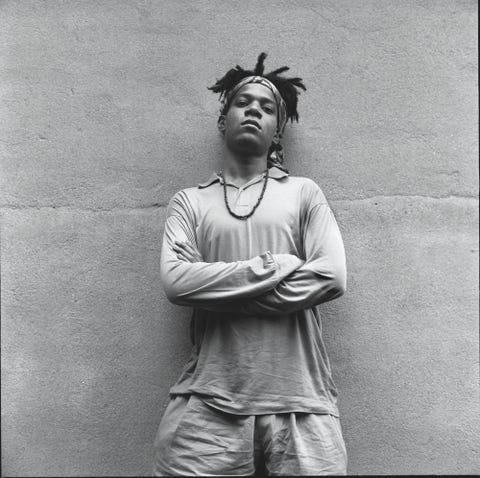
The story of Basquiat's rising typically goes something like this: Born in 1960 to Matilde Andrades, who was of Puerto Rican descent, and Gerard Basquiat, an accountant from Port-au-Prince, Haiti, Jean-Michel spent his early years in Brooklyn. When he was 8, his parents separated. He and his siblings at commencement lived with Matilde, who had moved back in with her parents, before she and Gerard decided together that it would be best for them to live with him in social club to maintain the stability and lifestyle they'd known before the divide. Gerard and the kids moved to a townhouse in Boerum Hill, Brooklyn, so relocated to Puerto Rico for a catamenia before coming dorsum to New York. Jean-Michel left home at 17 and began sleeping on park benches and living with a succession of girlfriends (including, for a brief period, a pre-fame Madonna). With his high school friend Al Diaz, he began to spray graffiti art throughout downtown Manhattan with the tag SAMO©. By the fourth dimension he was xx, he'd started a post-punk ring, Greyness, with filmmaker Michael Holman and actor Vincent Gallo and starred as a fictionalized version of himself in the indie film Downtown 81. He had also begun painting postcards, which he sold on the street, somewhen turning to canvases. Fast-forwards four years and he was one of the biggest art stars of the '80s, opening a show with Warhol, who had taken him under his wing (some said opportunistically), before Warhol's death in 1987 and Basquiat'southward ain excesses consumed him.
But at his height, Basquiat was still an outlier. Even though he achieved a level of fame and fortune unknown to any Black artist before him, he felt rejected by critics and cultural institutions alike. The New York Times review of "Basquiat, Warhol" referred to him as an "art world mascot," and his piece of work was regularly fetishized as "primitive" and "exotic."
Early attempts to memorialize him afterward his decease served to reinforce other pathological readings. Julian Schnabel'southward 1996 film, Basquiat, starring Jeffrey Wright, opens with Basquiat waking up in a cardboard box in Tompkins Square Park and depicts him as vivid but likewise volatile, indigent, and entirely denying his own middle-class upbringing. Phoebe Hoban'south unauthorized 1998 biography, Basquiat: A Quick Killing in Art, painted a stark and at times unsettling portrait of Basquiat's babyhood, ascent to fame, and descent into addiction.
During his life, Basquiat himself could be cryptic and evasive when it came to his past. When I ask the sisters how they feel about the fashion their family unit has been portrayed in or fifty-fifty left out of some of the more dominant accounts, Jeanine responds candidly: "It's less about what'due south not said. It's more about what is said," she explains. "What I have heard was that Jean-Michel left dwelling house and he was adopted by a white family. Or lived in a box. Or never saw his family unit over again. Or that Jean-Michel'south mother was locked away in an establishment for 30 years. These are things that are factually incorrect. And then it's more about correcting things than existence included in the story."
Withal, Basquiat did put his feel of racism and everyday vulnerability as a young Blackness human being in America forepart and center in his work. He was securely afflicted by the death of Michael Stewart, a 25-yr-old Black graffiti artist who fell into a coma after he was forcibly restrained and grunter-tied past police post-obit his arrest in a New York City subway station. (Stewart died 13 days later.) It inspired his 1983 piece The Death of Michael Stewart (as well known as Defacement), which he created on the wall of Keith Haring'due south studio. (Haring subsequently had it excavated and framed.)
"Jean-Michel's Blackness was always called into question by peers, by critics, by the art earth, by him just going through life mean solar day to day, so that was a constant," Jeanine says. "Y'all could tell how important it was to him past the mode he constantly referred to it in his piece of work. He had been dealing with it from a very young age. All those little microaggressions that well-nigh Black people experience weighed heavily on him." As cultural critic Greg Tate, who co- curated the "Writing the Future" exhibition at the MFA, Boston, observed in 2020, Basquiat repeatedly ruminated on Black artists and athletes in his work. "The loftier regard he had for jazz musicians is immediately credible," Tate wrote. "Charlie Parker, Dizzy Gillespie, Thelonious Monk, Max Roach, and other bebop kings totemically recur as gear up-made titans of Black male person genius—men the fame-, reward-, and respect-obsessed Basquiat knew were revered worldwide for their creative prowess, cosmopolitan style, and street cred."
Tate, who passed abroad in December, was too one of the first writers to explore Basquiat's links to hip-hop. Tate offered a landmark exploration of the subject in a 1989 essay for The Village Vocalism, "Nobody Loves a Genius Child: Jean-Michel Basquiat, Lonesome Flyboy in the '80s Art Boom Buttermilk." (The title is cribbed from a Langston Hughes poem.) Contemporary artists like Jay-Z and Swizz Beatz, who both collect Basquiat'due south work, have extended this lineage. ("I'm the new Jean- Michel," the old famously alleged on his 2013 song "Picasso Baby.")
Fortunately, there have been more recent attempts to shed light on Basquiat'south diverse Black cultural heritage and how he inspired his contemporaries and a new generation of Black artists who came of age after his expiry. Children's book author Javaka Steptoe won both the Caldecott Medal and Coretta Scott King Illustrator Honour in 2017 for his thoughtful portrait of Basquiat's early years in Radiant Kid: The Story of Young Artist Jean-Michel Basquiat. Art historian Jordana Moore Saggese'south 2014 book Reading Basquiat: Exploring Ambivalence in American Art is a scholarly examination of how Basquiat engaged his various identities, the cosmos of his work, and its complicated reception in the white fine art world, while Nigerian American filmmaker Julius Onah recently announced that he is making SAMO Lives, a new biopic celebrating Basquiat's life and African diasporic legacy.
Basquiat seldom spoke about his childhood in any depth in interviews. But he did credit his mother for nurturing his interest in art. When he began drawing at the age of three, often on paper that his father brought dwelling house from piece of work, Matilde would sketch alongside him. She took him frequently on trips to the Museum of Modernistic Fine art, the Metropolitan Museum of Art, and the Brooklyn Museum, to which Jean-Michel, at half dozen, had his own inferior membership. It was as well his mother who introduced him to the medical textbook Grayness'south Beefcake, which she gave him when he was 8 and hospitalized subsequently being struck by a car while playing in the street. Throughout his life, he constantly returned to it equally source material, naming his ring after information technology and using it in 1982 as inspiration for his first portfolio of prints, titled "Anatomy." Jean-Michel was not only a multilingual boyish, fluent in English language, French, and Spanish, he also grew up surrounded by his father's extensive record drove, heavy on jazz and bebop. "King Pleasance©" doesn't avert the more difficult parts of Jean-Michel'south life. Merely it does delve into the deep and complex nature of his human relationship with his family and how the sense of identity that his parents tried to build for their children helped shape him.
"This exercise of curating the show gave me a new perspective on how nosotros were each impacted by having him leave when he did," Lisane says. "We were 3 siblings, and one of the siblings is gone. This was my blood brother, and his life was stopped short, and in an instant. And when that happens, there's a freeze-frame for everybody. "He was incredibly protective," she adds. "He was funny every bit hell. He was mischievous. He was like this chief sorcerer, ever coming up with ane scheme afterward some other and recruiting Jeanine and I into the shenanigans. He was also figuring out who he was and what he wanted to do and how he wanted to testify up."
For Adjaye, "King Pleasure©" is most both recontextualizing Basquiat'south genius and also uncomplicating it. "What was very of import to me is for a young Black kid who is looking at this and thinking about being an artist to exist able to see themselves in information technology," Adjaye says. "So the story is made to unfold in a way that's relatable at present, not infrequent. Fifty-fifty though he's exceptional in that he's a moment in history at that fourth dimension, he's not exceptional in the sense of what Blackness families were doing for their children and trying to support them at that fourth dimension.
"All great artists write their narrative," Adjaye adds. "He was writing his own."
"I would encourage anyone to think nearly themselves in their early 20s, hanging out with their friends, and to imagine if someone were to take that sliver of your life and say, 'Let me tell you the story of this person,' " Lisane says. "And so it's not that it was wrong, but what this show volition practise is provide a view of Jean-Michel within the broader context of his life," she explains. "Jean-Michel was always determined as hell to do what he wanted to practice with his life, and that'southward what he did."
Years later, information technology seemed that Basquiat had internalized it all every bit a source of strength. "Since I was 17, I thought I might be a star," he said. "Fifty-fifty when I didn't think my stuff was that adept, I'd accept faith."
Hair: Tashana Miles at The Chair for The Chair Beauty; Makeup: Jessica Taylor.
This commodity originally appeared in the March 2022 issue of Harper'southward Bazaar, bachelor on newsstands March 1.
GET THE LATEST Effect OF Boutique
landerosbobjecied.blogspot.com
Source: https://www.harpersbazaar.com/culture/features/a38957580/reframing-basquiat-march-2022/
0 Response to "Reading Basquiat Exploring Ambivalence in American Art Jordana Moore Saggese"
Post a Comment