what happens to a married couple without a will in illinois
In my experience a very low pct of people bother to execute a will before their death and this low rate of manor planning is even more prevalent among people who dice at a young age or unexpectedly. Because of this, people commonly ask, who inherits if no will in Illinois.
This article will address how different types of property are distributed after expiry when someone dies without a volition or other estate planning documents. First, it will cover holding that is considered "not-probate property," which passes outside the rules of descent. And so the rules of descent and distribution (called "intestate succession") of probate property will be explained. Finally, several examples of intestate succession with be illustrated.
If you are an heir, executor, or administrator and think y'all might need an attorney, click this link to request a consultation.
Not-Probate Property
Understanding Property Buying and Beneficiary Designations
To sympathize who inherits when there is no will, it is necessary to understand what belongings volition become role of the probate estate and what holding volition pass outside of the probate process. Merely probate property follows the Illinois rules for descent and distribution. The easiest way to depict holding of the probate estate is to discuss what is not probate property.
Belongings Owned past Other People
Property owned by someone other than the person who died (he or she is called the "decedent") is not part of the probate estate and does not laissez passer to the decedent'due south heirs. Illinois isn't a community property state, so each spouse in a marriage owns property – even if caused during the spousal relationship. This can be a petty tricky because most property isn't formally titled, nonetheless, untitled property is usually of marginal value.
Titled belongings, such as real estate, vehicles, bank accounts and financial instruments are by and large owned by the titleholder. Holding owned by someone other than the decedent, such as a spouse, is not function of the estate and does not pass at death.
Belongings Owned Jointly
Property that is owned jointly with the right of survivorship or in tenancy past the entirety passes automatically to the other living owner(due south) at the time of death. This holding is not function of the probate manor and does not flow to the heirs through intestate succession.
Jointly endemic property is most ordinarily seen in real manor and banking company accounts.
Property with a Named Beneficiary
Holding with a named beneficiary as well passes outside of probate irrespective of whether there is a will or not.
However, there are two situations where property that ordinarily passes to a named beneficiary becomes part of the probate estate. The kickoff state of affairs is where the decedent never bothered to fill in the blank for a beneficiary, this is much more than common than ane would expect. The other situation is where the named beneficiary died before the decedent; in that example the property too becomes part of the probate estate (and so long as there are no successor beneficiaries named).
Belongings that commonly has a named casher includes investment accounts, retirement accounts and life insurance policies.
Transfer on Death Accounts
Transfer on death accounts are similar to property with a named beneficiary. These accounts were specifically designed to avoid probate and transfer immediately to the person named at the time of the decedent's death.
Transfer on decease accounts are about common at financial institutions and also are becoming more common in real manor ownership situations.
Property Held in Trust
The use of trusts are becoming more and more common. Typically, the person that is by and large considered the "owner" of the holding appoints themselves as trustee to hold the property in trust for themselves and then when a certain event occurs (usually death) the property flows to a successor trustee that holds the property for the benefit of themselves or others.
Other types of trusts do be, simply are less common, especially among people of average wealth. In some trusts the trustee owns the holding for the benefit of another right off the bat, these types of trusts are more common in wealthier families. Illinois too has state trusts, in which a trustee (usually Chicago Title and Trust Visitor) is the true legal owner and holds the real estate for the do good of beneficiaries designated in the trust instrument.
Bottom line, holding held in trust equally trustee is seldom part of a probate manor and the beneficial interest held by a casher of a trust is non usually part of a probate estate either.
Who Inherits the Probate Property If No Will in Illinois?
Now that nosotros know that not-probate property commonly flows to joint owners and beneficiaries regardless of whether or not there is a will, let's get to the bottom of the question at manus: who inherits probate holding nether Illinois law?
The Illinois Probate Act is the constabulary that sets along the rules for inheriting property in Illinois. It generally follows the convention of most states when it comes to inheritance, but there are a few quirks, notably that a married person's holding does not go entirely to their spouse if they also have children.
Generally, the holding passes "per stirpes," which means, that each branch of the family receives an equal share, so long as someone in that branch was living at the fourth dimension of death. At the end of this commodity, I'll provide some examples and charts to analyze this and other concepts.
Who Inherits in Illinois?
Below are the rules for inheritance that are usually used.
If the decedent had no descendants (children and grandchildren ect.) simply has a spouse, the unabridged manor to the spouse.
If there is a surviving spouse and descendants of the decedent and so ½ to the spouse and ½ to the descendants per stirpes.
If in that location is no surviving spouse, but descendants, the unabridged estate to the descendants per stirpes.
If there is no spouse, no descendants, only a parent, brother, or sis or descendants of a blood brother or sister, the entire estate goes to the parents, brothers and sisters as. However, if one parent is dead the surviving parent receives a double share an if at that place are descendants of a deceased brother or sis, they take per stirpes what the brother or sister would take received.
If there is no spouse, no descendants, no parents, no brothers, and no sisters, just a grandparent or descendant of a grandparent, ½ of the estate to the maternal grandparents or their descendants per stirpes if the grandparents are non alive and ½ to the paternal grandparents or their descendants per stirpes if the grandparents are non live.
The Illinois statute continues beyond this signal, but information technology is extremely rare to have to rely on the grandparents and their lines as intestate successors. If yous need to utilize more remote descent and distribution, reference 755 ILCS five/2-1.
Below are some examples forth with charts that illustrate who inherits if no will in Illinois.
Who Inherits If No Volition in Illinois Example 1
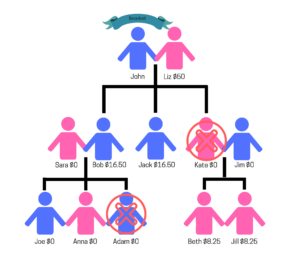
This nautical chart illustrates a fairly common example of intestate succession. The decedent, John, dies leaving a spouse, several children and grandchildren. One child, Kate, died earlier John as well as one grandchild, Adam.
John'south estate, nominally valued at $100.00 total, descends as illustrated above. John's wife receives half the estate and the other half flows to his children. Since Kate predeceased John, her share is split equally among her children. Her spouse does not inherit from her begetter.
Who Inherits If No Volition in Illinois Example 2
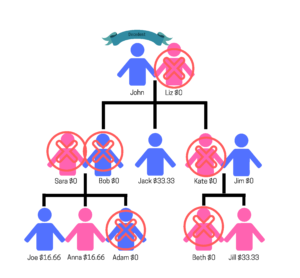
This chart illustrates a scenario where the decedent's spouse predeceased him leaving a child and grandchildren.
John'southward manor, nominally valued at $100.00 total, descends as illustrated above. Only one of John's children is alive at the time of his expiry, Jack, and he receives 1/iii. Bob and Kate's children receive an equal portion of their parent'due south share. The fact that Jim is all the same alive is immaterial every bit he does not inherit from his spouse'south male parent.
Who Inherits If No Will in Illinois Example 3
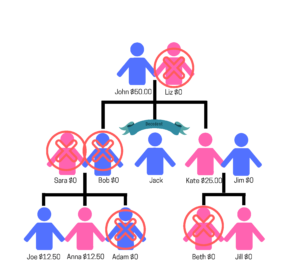
This chart illustrates a scenario where the decedent died leaving no direct descendants, but left one parent, a sibling and nieces and nephews.
Jack's manor, nominally valued at $100.00 total, descends as illustrated above. Jack's parents and siblings normally receive an equal share, but considering Jack's mom predeceased him his begetter receives a double share.
Since Bob predeceased Jack, Bob's children split up his share equally.
landerosbobjecied.blogspot.com
Source: https://bc-firm.com/who-inherits-if-no-will-in-illinois/
0 Response to "what happens to a married couple without a will in illinois"
Post a Comment